

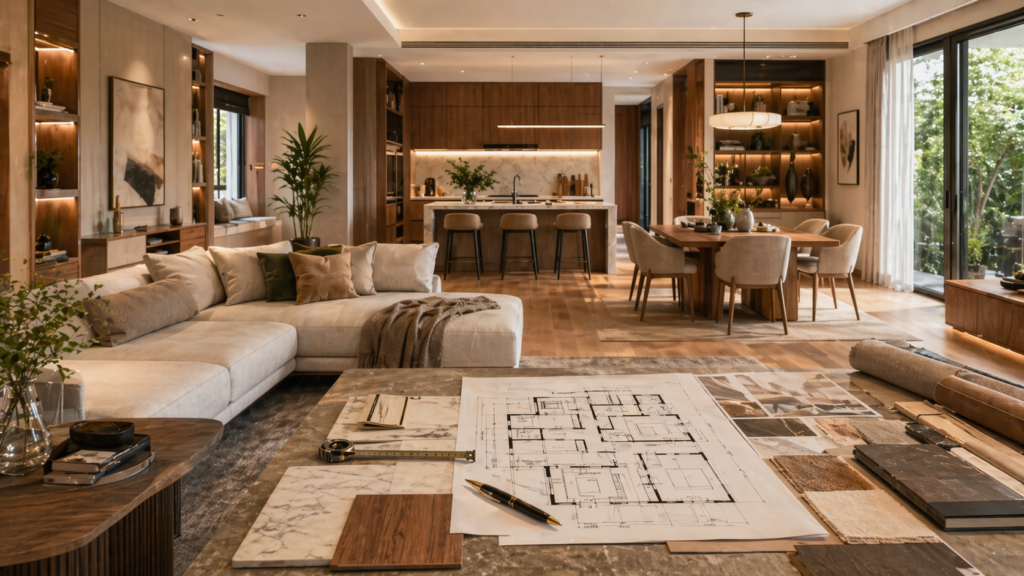
Knowing how to design luxury homes is not about square footage. It’s about strategy. Some of the most stunning homes in America today sit comfortably between 800 and 2,000 square feet, and they feel unmistakably high-end.
The challenge most new homeowners face? They don’t know where to start. With limited square footage, it’s easy to make design decisions that shrink a space visually, spend money on the wrong upgrades, or end up with a home that simply doesn’t flow.
This guide breaks down exactly how to design luxury homes, regardless of whether you’re working with a home design 800 sq ft, a 1500 sq feet home design, or a full 2000 sq feet home design. You’ll get professional-level strategies used by interior designers, architects, and real estate developers applied to real-world home sizes that most Americans actually live in.
By the end, you’ll know which design choices create genuine luxury, where to spend versus where to save, and how to make every square foot feel intentional and elevated.
Table of Contents ☰ ▲
▼
- What Makes a Home Feel Truly Luxurious?
- Understanding Your Square Footage: What’s Possible
- How to Design Luxury Homes: Start With the Floor Plan
- High-Impact Finishes That Signal Quality
- Lighting Design: The Secret Weapon of Luxury Interiors
- Kitchen and Bathroom Upgrades Worth Every Dollar
- Smart Home Technology for Modern Luxury
- How to Budget for a Luxury Home Design
- Key Statistics and Data Points
- Expert Tips and Pro Insights
- Comparison Table: Home Size vs. Luxury Features
- Frequently Asked Questions
- Conclusion
1. What Makes a Home Feel Truly Luxurious?
Before choosing paint colors or countertops, it helps to understand what luxury actually means. At its core, it’s not about price tags. It’s about intention, quality, and sensory experience.
Luxury design is the feeling you get when everything in a room seems to belong there. It’s cohesion. It’s the proportion. It’s the way warm afternoon light rakes across a textured surface and reveals its depth. These are the principles that guide professional designers, and they apply just as powerfully to a home design 1,000 sq ft as they do to a sprawling estate.
The Three Pillars of Luxury Home Design
- Quality over quantity fewer, better materials always outperform more, cheaper ones
- Visual flow sightlines, proportions, and spatial transitions that feel natural
- Sensory layering combining texture, light, sound, and scent for a holistic experience
A 900 sq feet home design with polished concrete floors, statement lighting, and bespoke millwork will feel more luxurious than a 2,000 sq ft box filled with builder-grade finishes. Keep that in mind throughout every decision.
2. Understanding Your Square Footage: What’s Possible
Every square footage range comes with unique design challenges and real opportunities. Here’s how professionals think about each range.
Home Design 800 Sq Ft
At 800 square feet, every design decision is load-bearing. This size is ideal for a studio or one-bedroom home and demands a ruthless focus on multifunctionality. Think Murphy beds with integrated cabinetry, kitchen islands that double as dining tables, and vertical storage solutions that draw the eye upward.
The luxury in an 800 sq ft home comes from precision craftsmanship and editorial restraint every object earns its place.
900 Sq Feet Home Design
With 900 square feet, you have just enough room to define separate zones without physical walls. Use area rugs, lighting pendants, and ceiling treatments to distinguish the living zone from the dining zone. Built-in shelving along one full wall can eliminate extra furniture while looking architecturally intentional.
Home Design 1000 Sq Ft
At 1,000 square feet, you can introduce a proper kitchen island, a second bedroom, and an en-suite bath. This is where luxury starts to feel truly spacious if you manage the layout well. Keep corridors to a minimum dead-end hallways eat square footage without adding value.
1500 Sq Feet Home Design
The 1,500 sq ft range is where most professionals see the biggest leap in perceived luxury. You have room for a dedicated dining space, a master suite with walk-in closet, and a home office nook. At this size, architectural detailing coffered ceilings, wainscoting, arched doorways starts to make a significant impact.
2000 Sq Feet Home Design / Home Plan Design for 2000 Sq Ft
A home plan design for 2000 sq ft is the sweet spot for family luxury living. You can accommodate three to four bedrooms, an open great room concept, a proper master suite, and even a mudroom that feels designed rather than purely functional. At this size, furniture scale and material selection become your most critical decisions.
3. How to Design Luxury Homes: Start With the Floor Plan
The single biggest mistake new homeowners make is treating the floor plan as fixed. Whether you’re designing from scratch or renovating, floor plan logic determines whether a home feels luxurious or not.
Open Concept Done Right
Open floor plans are ubiquitous because they work, but only when executed with discipline. In smaller homes (800–1,200 sq ft), an open plan maximizes perceived space and allows light to travel the full depth of the home. The key is defining zones without walls.
Use contrasting flooring materials, ceiling height variations, or a kitchen island to signal zone transitions. Without these anchors, an open plan just feels like one undifferentiated room.
Traffic Flow and Sightlines
Luxury homes feel spacious because sightlines are managed deliberately. When you walk through the front door, you should see a compelling view whether that’s a window, a fireplace, or a piece of art. This is called a visual terminus, and it’s a foundational principle in luxury residential design.
Design your traffic paths so they never bisect a seating area. In a 1,000 sq ft home design, this might mean positioning the sofa against a wall so the path from entry to kitchen runs along the perimeter, not through the center of the room.
Ceiling Height: The Underrated Luxury
You cannot buy more square footage, but you can buy height. Nine-foot ceilings are the minimum for luxury in any size home. Ten feet is transformative. Even a home design 800 sq ft with 10-foot ceilings and tall windows will feel palatial compared to a 1,500 sq ft home with 8-foot ceilings.
If you’re renovating, raising ceilings is one of the highest-ROI structural investments you can make.
4. High-Impact Finishes That Signal Quality
Finishes are what people touch and see up close. They’re the clearest signal of quality or the lack of it. Here’s where to invest and where to scale back without sacrificing the luxury feel.
Flooring: The Single Most Important Finish
Flooring covers the most visible surface in any home and sets the tone for every room. Wide-plank hardwood (at least 5 inches wide) in oak, walnut, or white oak signals luxury immediately. Engineered hardwood offers similar visual quality at a lower cost and is more stable in humid climates.
In bathrooms and kitchens, large-format tiles (24×24 inches or larger) with minimal grout lines create a sleek, high-end look. Avoid small mosaic tiles on floor surfaces in compact homes they fragment the visual field and make rooms feel smaller.
Color Palette Strategy
Color is the most accessible design lever available to new homeowners, and it’s consistently underestimated. A cohesive, intentional palette typically no more than three coordinated colors throughout the home signals design sophistication immediately.
For luxury interiors in smaller homes, lean toward a light, warm neutral base (warm white, soft greige, pale linen) with one or two deeper accent tones in millwork, cabinetry, or a feature wall. This creates depth without visual fragmentation. Consistent paint colors across adjacent rooms is one of the cheapest ways to make a home feel larger and more intentional.
Countertops and Cabinetry
In the kitchen, quartz countertops offer the most practical luxury durable, non-porous, and available in designs that convincingly mimic natural stone. For cabinetry, the hardware matters enormously. Matte black or brushed brass pulls on simple Shaker-style cabinetry elevate the entire kitchen instantly.
Full-overlay cabinetry where cabinet doors cover the entire frame for a seamless, built-in appearance looks significantly more custom than standard options and is available at most mid-range price points.
Millwork and Trim Details
Crown molding, door casings, and baseboards are the punctuation marks of a luxury interior. In a 1500 sq feet home design, investing in 5-inch tall baseboards and a simple crown molding profile throughout costs relatively little but has an outsized visual impact.
Coffered ceilings in the living or dining room speak immediately to architectural quality and they work in any home over 1,000 square feet.
5. Lighting Design: The Secret Weapon of Luxury Interiors
Professional designers consistently cite lighting as the single most transformative element of luxury interiors and it’s consistently overlooked by first-time homeowners.
Layered Lighting: The Three-Layer Rule
Every room in a luxury home should have three layers of light: ambient (general illumination), task (functional work light), and accent (decorative and architectural highlights).
Ambient lighting provides the base level of illumination. Task lighting serves specific functions like reading or food prep. Accent lighting creates drama uplighting on architectural columns, picture lights on artwork, or toe-kick lighting under kitchen islands.
Dimmer Switches Are Non-Negotiable
Every overhead fixture in a luxury home should be on a dimmer. The ability to shift from bright functional lighting to warm ambient light is the single cheapest luxury upgrade you can make. A $20 dimmer switch on a $300 chandelier transforms an ordinary room into something that feels thoughtfully designed.
Natural Light Maximization
In compact homes especially a home design 800 sq ft or a 900 sq feet home design natural light is the most powerful space-expanding tool available. Strategically placed mirrors on walls adjacent to windows effectively multiply the perceived light in a room.
Hang sheer curtain panels close to the ceiling and extend them past the window frame on both sides. This simple technique maximizes the visual size of every window without any structural work.
6. Kitchen and Bathroom Upgrades Worth Every Dollar
Real estate professionals universally agree: kitchens and bathrooms sell homes and define luxury. These two spaces deserve disproportionate investment, regardless of your total square footage.
Kitchen Design for Luxury Living
Even in a home design 1,000 sq ft, a well-designed kitchen can feel genuinely high-end. Three principles define a high-end kitchen: integrated appliances that blend with cabinetry, a statement range hood as the room’s visual focal point, and under-cabinet lighting that illuminates the work surface.
Each element does double duty it’s functional and architectural at the same time.
A waterfall-edge island where the countertop material cascades down the sides is a high-impact visual feature that photographs beautifully and adds perceived value immediately.
Bathroom Design: The Master Suite Experience
In a 2000 sq feet home design, a master bath with a freestanding soaking tub is the signature luxury feature. For smaller homes, a frameless glass walk-in shower with a rainfall showerhead and floor-to-ceiling tile delivers the same luxury sensation in a tighter footprint.
Heated floors in the primary bathroom are a worthwhile investment typically $800 to $3,000 for installation depending on bathroom size and deliver a sensory experience that far outweighs their cost.
Powder Room as a Jewel Box
The powder room is the one space in your home where guests spend time alone. This makes it the perfect canvas for a bold design statement dramatic wallpaper, a vessel sink, a statement mirror, or an unusual material like unlacquered brass or honed marble.
In a smaller home, a spectacular powder room signals design sophistication throughout the entire home.
7. Smart Home Technology for Modern Luxury
Twenty years ago, smart home technology was the exclusive domain of custom estates. Today, it’s accessible at every price point and adds genuine, daily-use value to any home.
Core Smart Home Systems
- Smart lighting systems (Lutron Caseta, Philips Hue) control mood and scene settings from your phone or a wall keypad
- Smart thermostats (Nest, Ecobee) self-learning thermostats that reduce energy bills while maintaining comfort
- Whole-home audio (Sonos) compact, invisible speakers that deliver high-quality sound in every room
- Smart locks and video doorbells integrated security that feels seamless, not bolted-on
Planning Technology Infrastructure
If you’re building new or doing a major gut renovation, plan your technology infrastructure before walls close. Running conduit for future wiring, installing a dedicated media panel (a central hub that organizes all your home’s data and entertainment wiring), and pre-wiring for motorized shades costs far less during construction than retrofitting later.
For a 2000 sq feet home design, hardwired ethernet ports throughout the home will future-proof your connectivity for the next decade something Wi-Fi alone cannot reliably guarantee.
Entry-Level Smart Home: Where to Start on a Budget
Not ready for a full smart home integration? Start with two targeted investments: a smart lighting system for your living room and primary bedroom, and a smart thermostat. Together, these two upgrades cost between $300 and $600, install without professional help, and immediately change how the home feels to live in.
From there, add whole-home audio and a video doorbell system as your second phase. Building incrementally is perfectly valid smart home technology is designed to scale.
8. How to Budget for a Luxury Home Design
For most new homeowners, budget is the most practical constraint in the design process. The good news: luxury is less about total spend and more about allocation. Where you put your dollars matters more than how many you have.
The 50/30/20 Design Budget Rule
Professional designers often allocate renovation budgets along these lines: 50% on structural and layout changes, 30% on finishes (flooring, kitchen, primary bath), and 20% on decorative elements (lighting fixtures, furniture, hardware, paint). This ratio ensures your largest investment goes to permanent improvements with the highest long-term impact.
In a 1,500 sq ft home with a $150,000 renovation budget, that breaks down to roughly $75,000 for structure and layout, $45,000 for key finishes, and $30,000 for the elements you’ll see and touch every day.
Where to Spend More
- Flooring the most visible surface in your home; buy the best you can afford
- Primary bathroom heated floors, frameless shower, quality fixtures
- Kitchen countertops and hardware high visual impact, touched multiple times daily
- Lighting fixtures a $400 pendant light in the right spot does more than $2,000 of ambient cans
Where to Save Without Sacrificing Quality
- Interior doors standard hollow-core doors upgraded with quality hardware read as premium
- Secondary bathrooms reserve the splurge for the primary bath; keep secondary baths clean and simple
- Window treatments quality linen sheers from mid-range retailers look as good as custom at a fraction of the price
- Paint a $70 gallon of premium paint in a deliberate color is one of the highest-ROI moves in design
9. Key Statistics and Data Points
Data-driven decisions lead to better design outcomes and stronger return on investment. Here are the numbers that matter most for luxury home design in the 800–2,000 sq ft range.
| Statistic | Insight |
|---|---|
| 72% | of homebuyers say open floor plans are a top luxury feature (NAR, 2024) |
| $85-$150 | average cost per sq ft for luxury interior renovation in the US (Remodeling Magazine, 2024) |
| 60% | of luxury home buyers prioritize smart home technology integration (NAR, 2024) |
| 61% | of home sellers recoup their kitchen renovation cost on resale – making it the highest-ROI room in the house (Remodeling Magazine Cost vs. Value Report, 2024) |
| #1 Factor | Natural light is the top feature homebuyers associate with a sense of spaciousness – ranked above square footage alone (Velux Daylight & Architecture Research, 2023) |
Sources: National Association of Realtors (2024), Remodeling Magazine Cost vs. Value Report (2024), Velux Daylight & Architecture Research (2023).
10. Expert Tips and Pro Insights
Pro Tip 1: Always design for the doorway first. What you see when you walk into a room determines your entire emotional response to that space. Position furniture and focal points to create a compelling view from every entry point.
Pro Tip 2: In compact homes, use a single dominant material rather than many competing ones. A kitchen with white quartz, white cabinets, and white subway tile reads as luxuriously cohesive. The same space with five different materials just reads as busy.
Pro Tip 3: Scale your furniture correctly. The most common mistake in luxury design for smaller homes is choosing furniture that’s too small. Undersized pieces make rooms feel sparse and cheap, not spacious. One large sofa is always better than two small ones.
Pro Tip 4: Invest in one genuinely beautiful, well-crafted piece per room. A hand-knotted rug (available from around $800 for smaller sizes) in an otherwise affordable living room will make the entire space feel elevated. Luxury is about anchoring, not uniformity.
Pro Tip 5: Don’t neglect the ceiling. It’s the fifth wall and is almost universally ignored. A coat of high-gloss paint on a ceiling reflects light and adds depth. Coffered ceilings, exposed beams, or even a wallpapered ceiling can transform a room from ordinary to memorable.
11. Comparison Table: Home Size vs. Luxury Features
Not sure what’s achievable at your square footage? Use this reference guide to align your design goals with your actual space.
| Home Size | Typical Layout | Key Luxury Features | Est. Renovation Cost |
|---|---|---|---|
| 800 sq ft | Compact studio/1BR | Multifunctional furniture, open-plan living | $80K–$150K |
| 900 sq ft | 1–2 BR starter home | Built-in storage, pocket doors | $90K–$165K |
| 1,000 sq ft | 2BR family starter | Kitchen island, en-suite bath | $100K–$180K |
| 1,500 sq ft | 3BR mid-range home | Dedicated dining, home office nook | $150K–$250K |
| 2,000 sq ft | 3–4BR family home | Master suite, open kitchen-great room | $200K–$350K |
Note: Renovation costs are estimates based on 2024 US national averages and will vary significantly by region, materials selected, and local labor rates.
12. Frequently Asked Questions
Q1: Can a small home really feel luxurious, or do you need a large space?
Absolutely square footage and luxury are not the same thing. Many of the most celebrated residential designs in the world are compact. What creates luxury is quality of materials, intentional spatial planning, excellent lighting, and sensory cohesion. A well-designed 800 sq ft can feel more luxurious than a poorly executed 3,000 sq ft house.
Q2: What is the most important single investment for luxury home design?
Flooring. It covers the most visible surface in your home and sets the visual tone for every other finish. Wide-plank hardwood or high-quality large-format tile signals quality immediately to anyone who walks through the door. If the budget is limited, allocate disproportionately to floors.
Q3: How do I make a 1,000 sq ft home feel bigger?
Three strategies: maximize natural light (add mirrors adjacent to windows, hang sheer curtains high and wide), maintain a consistent flooring material throughout the home (no transitions = one large perceived space), and keep your color palette cohesive and light-toned. Built-in storage eliminates visual clutter which is the single biggest enemy of perceived space.
Q4: What does a luxury home plan design for 2000 sq ft typically include?
A well-designed home plan design for 2000 sq ft typically includes: an open great room concept combining kitchen, dining, and living; a master suite with a walk-in closet and spa-quality bath; two to three additional bedrooms; a dedicated home office or flex room; a mudroom or drop zone; and a laundry room with proper cabinetry.
Q5: Is smart home technology worth the investment for a smaller luxury home?
Yes, and it’s more impactful in smaller homes than larger ones. Smart lighting, integrated audio, and automated shades can transform the sensory experience of a compact space without taking up any square footage. Start with a smart lighting system and a whole-home audio solution for the highest immediate impact.
Q6: How should I prioritize renovations in a 1500 sq feet home design on a limited budget?
Prioritize in this order: (1) structural and layout improvements remove walls that block light and flow; (2) kitchen and primary bath upgrades these have the highest resale impact; (3) flooring throughout; (4) lighting add dimmers and layer your sources; (5) finish details millwork, hardware, and paint. This sequence maximizes both livability and return on investment.
Q7: What are the most common luxury home design mistakes new homeowners make?
The most frequent mistakes: choosing furniture that’s too small for the space, using too many colors and materials (lack of cohesion), neglecting lighting planning until it’s too late, underestimating the importance of storage, and over-personalizing in ways that reduce resale appeal. When in doubt, choose timeless over trendy.
13. Conclusion
Learning how to design luxury homes isn’t about having the biggest budget or the most square footage. It’s about understanding the principles that create quality, comfort, and visual sophistication and then applying them with discipline.
Whether you’re working with a home design 800 sq ft or a full 2000 sq feet home design, the same fundamentals apply: respect your floor plan, invest in quality finishes, design your lighting intentionally, and let every decision serve the whole. A home that feels luxurious is one where nothing is accidental.
You don’t need to hire a $500-per-hour designer to achieve these results (though it doesn’t hurt). What you do need is a clear strategy, a willingness to prioritize quality over quantity, and the patience to make considered decisions rather than impulsive ones.
Your home is the single largest investment most Americans will ever make. Design it like it matters because it does.