

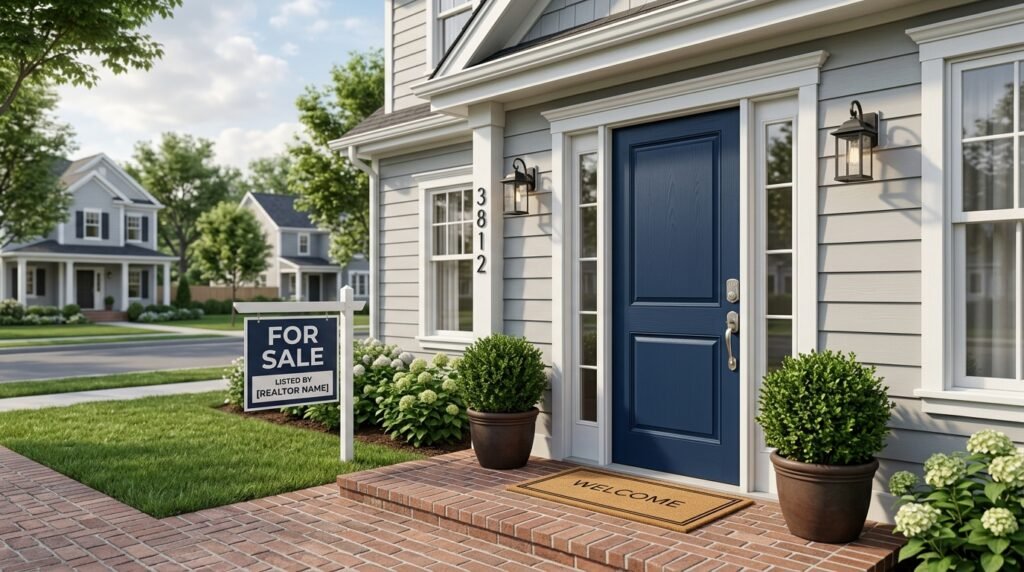
Zillow’s 2018 paint color analysis found that homes with a black or charcoal gray front door sold for $6,449 more than expected. That figure has dominated the conversation around the best front door colors to sell a house for nearly a decade – and it’s still the most-cited dataset because no comparable study has replaced it. But it isn’t the whole story. In hotter Sun Belt markets, recent staging data points to slate blue outperforming black, and on the wrong house style, even a perfect black can knock value off your listing before a buyer schedules a showing.
Below, the five colors that move houses fastest, the buyer psychology behind each, and how to match the right one to your house style and region.
Front Door Colors to Sell: The 5 That Move Houses Fastest
These front door colors to sell a home show up repeatedly in pricing data, buyer surveys, and agent reports. Each entry below includes the sale-price impact, the styles it suits, the styles it kills, and a specific paint code to take to the store.
1. Black / Charcoal – Tricorn Black SW 6258 (Sherwin-Williams)
Sale-price impact: +$6,449 on average, per Zillow’s paint color analysis. The strongest single data point in the front door colors that increase home value conversation.
Best on: Colonials, Cape Cods, Federals, Georgians, traditional brick homes, modern farmhouses with white siding.
Avoid on: Spanish Revival, Mediterranean, adobe, and most stucco homes in earth-tone palettes. Black comes across as heavy and architectural; warm-toned houses fight it.
Tricorn Black is the safest pick because it’s a true neutral black with no blue or brown undertone. Benjamin Moore’s Black HC-190 is a comparable alternative if you’re matched to a BM swatch deck.
2. Navy Blue – Hale Navy HC-154 (Benjamin Moore)
Sale-price impact: Positive lift across multiple agent surveys and 2024 staging industry reports, with the highest cross-demographic appeal in recent buyer color preference data.
Best on: Cape Cod, coastal homes, Craftsman, Dutch Colonial, white or light gray siding.
Avoid on: Yellow-toned beige siding, where navy reads cold and clashy.
Hale Navy is the most-specified navy in real estate staging guides because it photographs as a deep, slightly warm blue rather than going purple in shadow. Sherwin-Williams Naval SW 6244 is the equivalent.
3. Deep Red / Wine – Caliente AF-290 (Benjamin Moore)
Sale-price impact: Mixed. Positive lift in the Northeast and Midwest on traditional housing stock. Neutral to negative on contemporary homes and in buyer segments under 35.
Best on: Colonial, Georgian, Federal, Tudor, brick traditional. Red signals confidence and welcome to older buyer brackets (45+).
Avoid on: Anything built after 1995 in a contemporary or transitional style. The rule for red: pre-war or skip it.
Caliente is a deep, slightly muted red that avoids the fire-engine look that ages a house. Sherwin-Williams Show Stopper SW 7588 is similar.
4. Forest Green / Olive – Essex Green HC-188 (Benjamin Moore)
Sale-price impact: Strong positive lift in 2023-2024 staging data, particularly on Craftsman and ranch homes in regions with mature tree coverage.
Best on: Craftsman, Tudor, Prairie, stone-front ranches, homes with wood shake or natural cedar accents.
Avoid on: Pink-beige stucco, anything with red brick where the green and red will compete.
Essex Green looks almost black until sunlight hits it, then resolves into a deep forest. That photographic quality is why stagers reach for it: it commands the door on the thumbnail without screaming.
5. Slate Blue – Wrought Iron 2124-10 or Knoxville Gray HC-160 (Benjamin Moore)
Sale-price impact: Positive, with strongest performance in Sun Belt markets where Opendoor’s 2024 market reporting suggests slate outperforms black on contemporary inventory. Heat-absorption and fade issues hurt black doors in these regions.
Best on: Modern, transitional, mid-century, contemporary ranch, Southwestern homes with gray or taupe palettes.
Avoid on: Strict traditional colonials, where slate looks soft and undermines the architectural symmetry.
Slate is the dark-horse pick. It signals “updated” without the commitment of black, and it is the color most likely to read modern in a 280-pixel listing thumbnail.
What Buyers Actually Feel When They See Your Door
Front door colors do more than decorate – they trigger fast judgments. Color psychology in real estate is mostly recycled vibes. The useful version ties front door colors to buyer demographics and survey data.
Black polls as “sophisticated” and “updated” across all age groups in agent buyer surveys. It is the only color that does not lose ground with any demographic, which is why it leads the black front door home sale data.
Navy is the highest cross-bracket scorer. It comes across as “trustworthy” to 45+ buyers and “current” to under-35s. No other color performs in both segments.
Red signals confidence and tradition for buyers over 50 and looks dated to under-35 shoppers. If your buyer pool skews young (urban infill, starter homes under `$400k), red costs you.
Green scores high on “welcoming” and “connected to nature,” which is why it overperforms in markets with mature tree coverage and underperforms in newer subdivisions.
Yellow, orange, and turquoise score as “personality” colors. Buyers like them in someone else house. On their potential house, they look like a project.
The practical takeaway for sellers who do not know their buyer profile: navy is the lowest-risk pick. It is the only color that polls well with both ends of the age spectrum, which matters when your listing is going to be seen by thousands of buyers with different tastes. When you weigh front door colors to sell on, default to the option with the widest demographic reach.
Matching Front Door Colors to Sell by House Style
This is where most articles on the best front door colors to sell a house stop short. Black is the answer on a Connecticut colonial. It is the wrong answer on a Phoenix Spanish revival, where the heat will cook the finish and the style fights the color. Match before you paint.
Colonial and Federal. Black, deep red, or Hale Navy. Symmetry is the architectural rule, and a saturated single color reinforces the central axis of the door. Avoid anything that pulls the eye off-center: no two-tones, no panels in different finishes.
Craftsman. Forest green, olive, mustard, deep red, or warm browns. Craftsman bungalows were built around earth tones and natural materials. A green or red door echoes the original Stickley palette. Black works but looks a bit modern; navy looks borrowed from a colonial.
Ranch (1950s-70s). Slate blue, soft black, or a muted teal. Long horizontal facades need a door that punches without overwhelming. A high-gloss black on a ranch can look stark; a semi-gloss slate or charcoal modernizes the house instantly.
Modern and Contemporary. Black, slate, or natural wood stain. Restraint is the design language. Stay away from primary colors, which fight clean architectural lines. A natural mahogany or walnut stain on a modern door looks expensive even when it is not.
Spanish Revival and Mediterranean. Warm wood tones, terracotta, burnt orange, or a muted teal. Black is wrong here, full stop. Spanish architecture uses warm earth tones, and the door should sit inside that palette, not contrast it. Sherwin-Williams Cavern Clay SW 7701 or a clear-stained mahogany are stronger choices.
Victorian. This is the one style where a multi-color door is appropriate and historically accurate. Deep purple, burgundy, forest green, or a period-accurate three-color scheme. The Painted Ladies tradition is not a gimmick; it is documented Victorian taste. A single black door on a Victorian flattens the architecture.
Regional Tips for Front Door Colors to Sell
Climate and local taste shift the rankings. A few patterns worth knowing before you commit to one of these front door colors to sell your home.
Arizona, Nevada, New Mexico, inland Southern California. Black and dark colors absorb heat and can warp wood or fiberglass doors and fade in 18 to 24 months. Use a heat-reflective formula (Sherwin-Williams Emerald Exterior or Benjamin Moore Aura Grand Entrance) or step to slate, sage, or terracotta.
Florida, Gulf Coast, Carolinas coast. Salt air strips finish. Marine-grade paint (formulated with extra UV inhibitors and salt resistance) is non-negotiable. Coastal blues, soft grays, and whites photograph best for listing thumbnails in these markets.
Northeast and Midwest. The strongest market for classic colors – black, deep red, Hale Navy, forest green. Buyers here pay a premium for “traditional” cues, and the door is one of them.
Pacific Northwest. Olive, forest green, and warm browns outperform. The regional palette runs to natural materials, and a glossy black can look out of place against cedar or stained wood siding.
HOA-governed communities. Check your covenants before you buy paint. Many planned communities have approved-color lists, and painting outside them can trigger fines or force you to repaint mid-listing. Submit your color choice to the architectural review committee at least 30 days before painting. Most HOAs have a 14 to 30 day review window. If you are listing in under 60 days, get HOA approval before the paint enters your garage.
Front Door Colors That Hurt Your Sale Price
Some front door colors actively cost money. Pricing data and buyer surveys show clear losers, not just neutral colors.
Bright yellow. Polls lowest across every age and region segment. Looks like a “personality project” and signals to buyers that more cosmetic decisions in the house were made the same way.
Neon or saturated primary colors. Lime green, electric blue, hot pink. Strong personal-brand colors that suppress offer prices because buyers immediately price in the cost of repainting.
Builder-grade beige or oak stain. Not actively harmful, but the worst opportunity cost. A faded beige door tells buyers nothing about the house. The $50 of paint to upgrade it is the highest-ROI prep work on the property.
Mismatched-to-trim. A door painted in a tone that fights the window trim or shutters reads as renovation-incomplete. If your shutters are a warm brown, do not pick a cool gray door. Pull the door color from a tone already in the facade.
Glossy fire-engine red. Different from a deep wine red. Pure bright red dates a house to the 1990s and underperforms in every market.
How to Paint Front Door Colors the Right Way Before Listing
Picking from the best front door colors to sell is only half the job – application decides whether it actually lifts your price. Paint quality matters less than prep. A bad prep job on premium paint will lose to a careful job on mid-tier paint, every time.
Prep. Remove the door from the hinges if you can. Lay it flat on sawhorses for an even finish and no drips. Sand the existing finish with 220 grit until it is dull across the entire surface, wipe with a tack cloth, and fill any dings with exterior wood filler. Skipping the sand step is the single most common reason DIY door paint jobs peel within a year.
Primer. Use a bonding primer if you are going over a glossy finish or switching from a light to dark color. Zinsser BIN or Sherwin-Williams Extreme Bond are both reliable. One coat is enough on a properly sanded door.
Finish. Use semi-gloss or satin. Semi-gloss is the standard for front doors because it photographs with depth, resists fingerprints, and cleans easily. High-gloss on a door is a style choice that works on contemporary homes and looks wrong on most traditional styles. Two thin coats with a foam roller for the panels and a quality angled brush for the trim and edges.
Cost. DIY: $40 to $80 for a quart of premium exterior paint, primer, sandpaper, brushes, and a foam roller. Hired out: $200 to $400 for a single-door repaint, depending on prep needed. The hired cost is reasonable if your door has multiple peeling layers or detailed paneling, but it is one of the few projects where DIY actually delivers a professional result.
Timing before listing. Paint at least 7 to 10 days before listing photos. Fresh paint needs time to cure to its true color and lose the wet sheen that can throw off photography. If you are painting for showings rather than for photos, 48 hours of cure time is the minimum to avoid fingerprints and door-handle marks.
Your Door Is Doing SEO Inside the MLS
Most homeowners pick a door color thinking about how it looks from the curb. The decision that actually moves your sale price happens earlier: in the Zillow grid, where a buyer is scrolling through 40 listings and seeing your house at 280 pixels wide.
At that size, siding color and architectural detail blur into noise. The door is the single highest-contrast object in the frame. A black, navy, or forest green door creates a focal point that pulls the eye and registers as “updated.” A faded beige door at thumbnail size disappears entirely, which means your listing comes across as visually quieter than the listings around it. Buyers click on what catches the eye. Your click-through rate determines how many showings you book in the first 72 hours.
The takeaway: pick the color that looks best at 280 pixels, not the one that looks best on the front porch. Open your draft listing photo on your phone. If your door does not pop at thumbnail size, repaint it before the photographer comes back – then work through the rest of our pre-sale curb appeal checklist so the whole exterior is listing-ready, not just the door.
Pick From the Best Front Door Colors and Get It Done
The best front door colors to sell a house are not a matter of taste – they are a matter of matching pricing data to your specific house style, region, and listing timeline. Three steps before you buy paint:
- Pick from the ranked five. Match the color to your house style using the section above. Do not deviate.
- Check HOA covenants. Submit for approval at least 30 days before painting.
- Paint 7 to 10 days before listing photos. Use semi-gloss, two thin coats, properly sanded.
A $50 quart of paint and a Saturday afternoon is the single highest-ROI move in pre-listing prep. Do it before the photographer arrives, and your listing will pull more clicks, more showings, and stronger offers from day one.
FAQ
Does a black front door really increase home value?
On the right side of the house, yes. Zillow’s 2018 paint study found a black or charcoal gray front door correlated with a $6,449 sale price lift, the largest single-color effect in the study. The lift is strongest on colonials, Cape Cods, traditional brick homes, and modern farmhouses. On Spanish Revival, Mediterranean, or stucco homes in warm earth tones, a black door can actually depress offers.
What are the most popular front door colors to sell a house in 2026?
Soft black and slate blue lead 2026 staging guides, with Hale Navy holding steady as the cross-demographic winner. Olive green is the rising color in the Northwest and on Craftsman homes. Pure white and beige doors continue to underperform every other choice in resale data.
Should the front door match the shutters?
Match or coordinate, but do not pick the door color in isolation. The strongest curb appeal pulls the door color from a tone already in the facade – either the shutters, the trim, or a stone or brick element. A door that fights the shutters looks visually unfinished and costs you money at the offer stage.
How long before listing should I paint the door?
Seven to ten days before listing photos. Paint needs time to cure and dull to its true color, and a freshly wet-looking door photographs badly. If you are painting between photos and showings, 48 hours is the minimum cure time before buyers touch the handle.
Will repainting my front door pay for itself?
Almost always. A DIY repaint costs $40 to $80 and the typical sale-price lift from the top-performing colors ranges from a few hundred dollars on the low end to $6,449 on the high end. That is the highest ROI of any cosmetic pre-listing project, measured per dollar spent.
Sources
- Zillow Paint Color Analysis (2018) – original sale-price-by-color dataset cited throughout.
- NAR Remodeling Impact Report – exterior project ROI and buyer preference context.
- Benjamin Moore Exterior Color Guides – paint codes and exterior performance specs.