

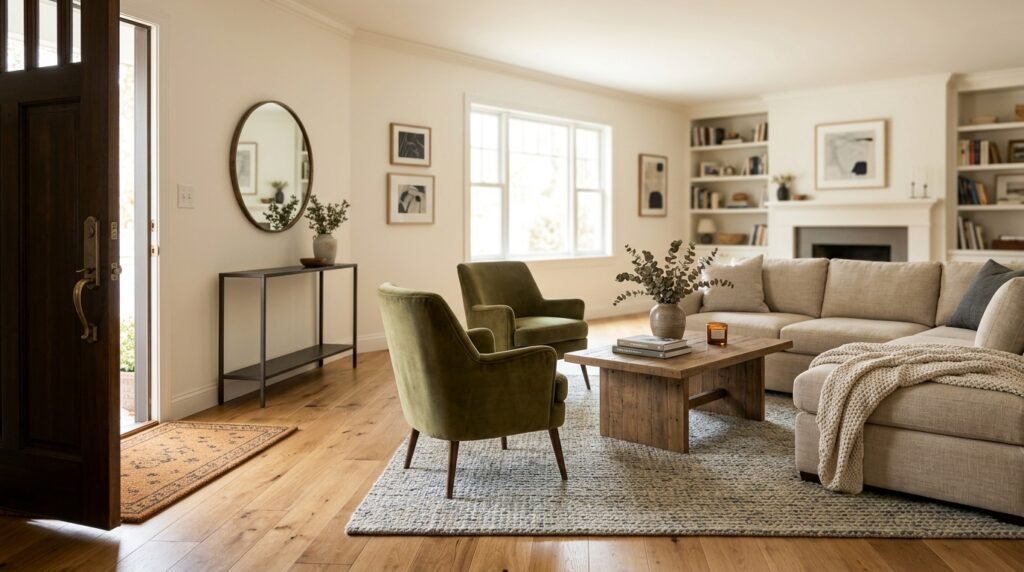
A bad living room furniture layout turns an awkward entry door into a daily headache: your front door swings open and you are standing in the middle of the living room, with a sofa three feet from the doorknob and a traffic path that cuts the room in half.
If that sounds familiar, you are not alone. In fact, awkward entry doors are one of the most common layout headaches in older homes, apartments, and open-concept builds. As a result, the wrong setup makes the whole space feel cramped, chaotic, and unwelcoming the second someone walks in.
The good news? Fortunately, a smart living room furniture layout can completely fix it – without knocking down walls or buying all-new furniture. In short, the right arrangement controls traffic flow, defines zones, and makes even the most awkward door feel intentional.
In this guide you will get room-by-room layout strategies, real-world examples, expert tips, and a comparison of the best approaches for different door placements. By the end, you will know exactly how to arrange your living room so the door works with your space, not against it.
Table of Contents
● Why Awkward Doors Wreck Your Living Room Furniture Layout
● Step 1: Map Your Traffic Path First
● Best Living Room Furniture Layouts by Door Position
● How to Create a Faux Entryway
● Furniture Pieces That Solve Awkward Doors
● Key Statistics and Layout Data
● Expert Tips and Pro Insights
● Layout Comparison Table
● Frequently Asked Questions
● Your Living Room Furniture Layout Action Plan
Why Awkward Doors Wreck Your Living Room Furniture Layout
An entry door is not just an opening – it is a traffic generator. Specifically, every time it is used, it creates a movement zone that furniture cannot occupy. Therefore, when that door lands in a bad spot, it eats into the most usable part of the room.
As a result, the outcome is predictable: a floating sofa nobody knows where to put, a coffee table you keep bumping, and a living room that feels smaller than it actually is.
The Three Most Common Awkward Door Scenarios
Generally, most living room layout problems trace back to one of these:
● Door opens directly into the seating area – guests walk straight into the back of your sofa.
● A long side wall, meanwhile, splits the room into two unusable halves.
● Two or more doors compete – front door, hallway, and patio door all cross in the same zone.
Why Pushing Everything to the Walls Fails
The instinct is to shove all furniture against the walls to clear a path. However, it rarely works. Instead, you end up with a hollow center, conversation areas that are too far apart, and a room that still feels like a hallway.
A great living room furniture layout is not about emptying the middle – it is about directing movement around purposeful zones. If your room is also short on square footage, pair this with our small-room layout ideas for extra space-stretching tactics.
Step 1: Map Your Traffic Path First
Before you move a single chair, first trace the invisible line people walk from the door to the rest of the home. Indeed, this is the single most important step in any living room furniture layout.
How to Map It in 5 Minutes
- Stand at the entry door. This is your starting point.
- Walk the natural route. Move toward the kitchen, hallway, and other exits.
- Mark the path. Use painter tape on the floor so you can see it.
- Keep it 30 to 36 inches wide. Clear that lane of all furniture.
- Arrange everything else outside the lane. Furniture lives on the banks, not in the river.
The Landing Zone Rule
Every entry door needs a small landing zone – roughly 3 feet of clear space just inside the door. Essentially, this gives people room to enter, pause, and turn without crashing into furniture. As a result, protecting this zone instantly makes an awkward door feel less awkward.
Best Living Room Furniture Layouts by Door Position
There is no single best layout; instead, the right one depends entirely on where your door lands. Below, you will find proven solutions for the four most common situations.
Layout A: Door Opens Behind the Sofa
This is the classic apartment problem. The fix: float the sofa with its back partially toward the door, then anchor it with a console table behind it. As a result, the console becomes an instant drop zone for keys and bags and visually separates the entry from the seating area – without a single wall.
Layout B: Door on a Long Side Wall
Here the door splits the room. The solution: create two distinct zones. For example, put the main seating area on the far end away from the door and a small secondary zone – reading chair, plant, slim bookcase – near the entry. Now the door belongs to the transition zone, not the living space.
Layout C: Door in a Corner
Corner doors are actually the easiest to work with. Simply angle a chair or sectional toward the room focal point (TV or window), and then let the diagonal path flow naturally past it.
The 45-Degree Trick
For instance, angling one key piece – like an accent chair – at 45 degrees softens the corner, fills dead space, and guides foot traffic without blocking it.
Layout D: Multiple Competing Doors
When several doors converge, pick one primary path and make it obvious. Then use a rug to define the seating zone off that path. Essentially, everything inside the rug is stay; everything outside is pass through. Ultimately, a rug is the cheapest, fastest way to tell the eye where the room actually begins.
How to Create a Faux Entryway
When a door dumps you straight into the living room, the missing piece is a transition. Fortunately, a faux entryway gives the brain a moment to adjust – and makes the layout feel designed, not accidental.
Three Ways to Fake an Entryway
● Console + mirror combo: a narrow console table against the nearest wall, topped with a mirror, instantly reads as entry.
● Open shelving or a slim bookcase: positioned perpendicular to the door, it acts as a half-wall divider while staying airy.
● Area rug change: a small rug at the door that differs from the main living room rug visually signals this is the entry.
The Half-Wall Furniture Divider
A backless bookshelf or sofa table placed perpendicular to the door creates psychological separation without closing off the room or light. You can pull this off using pieces you already own – see our ideas to refresh a space without buying new furniture for budget-friendly divider hacks.
Furniture Pieces That Solve Awkward Doors
Notably, some pieces are problem-solvers by design. Therefore, prioritize these when your door placement is fighting your living room furniture layout.
A console table. The MVP of awkward-door living rooms. Specifically, behind a floating sofa or against an entry wall, it defines zones, adds storage, and creates that crucial landing surface.
An armless or slim-arm sofa. Bulky rolled arms eat 6 to 10 inches per side. A slim-arm or armless sofa buys back walking space without losing seating.
A round coffee table. Because there are no sharp corners, you avoid painful collisions on a tight traffic path. Overall, a round table is more forgiving in high-movement living rooms.
Nesting tables and ottomans. Flexible, movable, and tuck-away. They flex with traffic instead of blocking it – exactly what an awkward layout needs.
Key Statistics and Layout Data
Layout is not just aesthetic; importantly, the measurements matter. So keep these numbers on hand:
● Walkways: maintain 30 to 36 inches for primary traffic paths; 24 inches minimum for secondary paths.
● Coffee table distance: leave 14 to 18 inches between the sofa and coffee table for legroom.
● Conversation distance: seating should be no more than 8 feet apart for natural conversation.
● TV viewing distance: roughly 1.5 to 2.5x the screen diagonal in seating distance.
● Rug sizing: at least the front legs of all major seating should sit on the area rug.
● Entry landing zone: protect about 3 feet of clear space inside any entry door.
Expert Tips and Pro Insights
First, float furniture confidently. Beginners cling to walls, whereas designers float. In practice, a floating sofa with a console behind it solves more awkward-door problems than any other single move.
Next, lead the eye past the door. For example, place a visual anchor – art, a statement plant, a feature chair – on the wall opposite the door, so the awkward door becomes background noise.
Also, use lighting as a zone marker. Similarly, a floor lamp beside the seating area quietly tells visitors this is the living space, separate from the entry.
Then scale down; do not multiply. Generally, fewer well-placed pieces beat many small ones. In short, clutter amplifies awkwardness, whereas restraint neutralizes it.
Finally, test with tape before you lift. Basically, tape the footprint of every major piece on the floor, live with it for a day, and then adjust before moving heavy furniture.
Layout Comparison Table
| Layout Strategy | Best For | Key Piece Needed | Difficulty | Space Use |
| Float sofa + console | Door behind seating | Console table | Easy | High |
| Two-zone split | Door on long wall | Accent chair / bookcase | Medium | Medium |
| 45-degree angle | Corner door | Angled chair/sectional | Easy | Medium |
| Rug-defined zone | Multiple doors | Large area rug | Easy | High |
| Half-wall divider | Open-concept entry | Backless bookshelf | Medium | High |
Frequently Asked Questions
How do you arrange a living room when the front door opens right into it?
First, float your sofa with a console table behind it to create a buffer. Then protect a 3-foot landing zone at the door, and finally use a rug to define the seating area away from the traffic path.
Where should the sofa go if the door is behind it?
Position the sofa so its back partially faces the door; then anchor it with a console or sofa table. As a result, this creates an instant visual divider and a functional drop zone.
What is the best living room furniture layout for a small room with an awkward door?
A floating slim-arm sofa, a round coffee table, and a single area rug to anchor the zone. Keep the traffic path 30 inches wide and minimize the number of pieces.
How do I create an entryway when there is not one?
For instance, add a console table with a mirror, a perpendicular backless bookshelf, or a small contrasting rug at the door. Either way, each signals entry without building a wall.
How wide should a walkway be in a living room?
Primary paths should be 30 to 36 inches wide. Meanwhile, secondary paths can drop to about 24 inches minimum for comfortable movement.
Should furniture touch the walls in an awkward living room?
Not always. In fact, pushing everything to the walls often makes the room feel like a hallway. Instead, floating key pieces usually fixes awkward-door flow better.
Can a rug really fix an awkward layout?
Yes. A correctly sized rug visually defines the seating zone and separates it from the entry path – one of the cheapest, highest-impact fixes available.
Your Living Room Furniture Layout Action Plan
An awkward entry door does not doom your living room – a poor layout does. However, once you map your traffic path, protect the landing zone, and float your furniture with intention, that problem door becomes a non-issue.
So start with one move today: grab painter tape, mark your traffic path, and test the float-the-sofa layout this weekend. Honestly, you will feel the difference the moment you walk in.Ready to keep going? For more high-impact, low-cost wins around the rest of your home, explore our roundup of budget-friendly ways to update your home.