
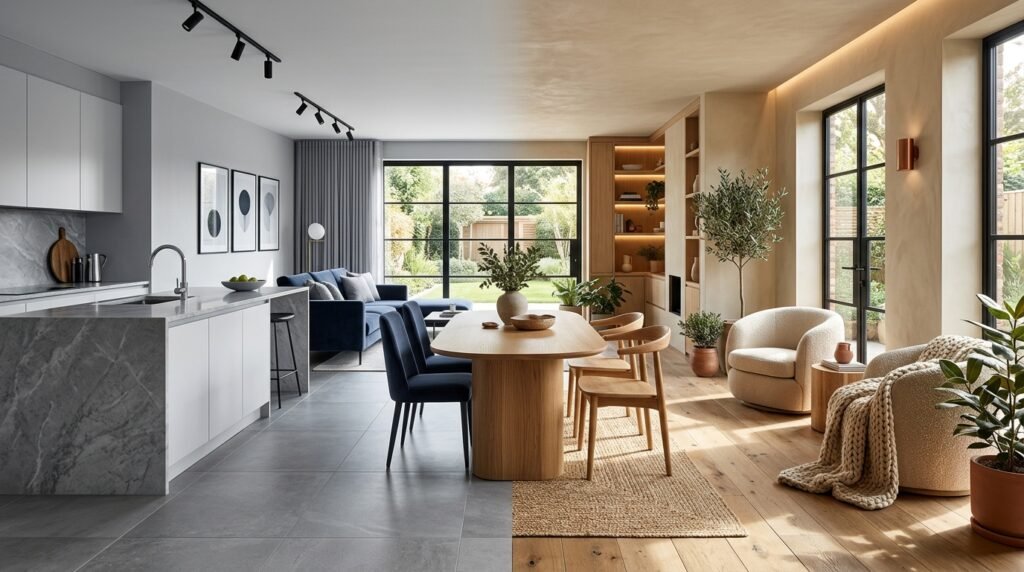
Some home design trends date faster than the renovation invoice. Walk into a room finished in 2020 and you can usually date it within a year – all-gray walls, matte black everything, a curvy boucle sofa, a zellige backsplash. None of it was a mistake. It was just everywhere, and the looks that saturate the hardest age fastest.
Most articles on home design trends hand you a list and stop there. That is the gap this one closes. You will get the dated looks ranked by how much they actually hurt the room, what each fix costs, and a separate answer if you rent and cannot tear out a backsplash. Some of these are worth fixing this weekend. Others you can ignore for two more years without anyone noticing. Knowing the difference is the whole point, because spending USD 4,000 to chase a trend you will regret in 2028 is its own kind of date. The 2026 data section uses real survey numbers, not a designer hunch, so you can see where other homeowners are actually putting their money.
Why Home Design Trends Date So Fast (The Saturation Rule)
A look does not age because it is ugly. It ages because it stopped signaling taste and started signaling a date. The mechanism behind fading home design trends is saturation.
When a finish jumps from design magazines to every flip, every rental upgrade, and every big-box display within about three years, it loses the thing that made it feel considered. Designer Terri Brien put it plainly in Apartment Therapy: when something shows up consistently, it starts to lose what made it special.
That is why the hardest-peaking trends fall hardest. Matte-black-on-white kitchens hit maximum penetration around 2020; five years on they read as a specific moment, not a neutral choice. The trends safest from this are the ones that are never fully saturated, or that have survived multiple cycles already.
The one-glance test: stand in the doorway and look for two seconds. If your eye lands on a single high-contrast feature first – the hardware, the accent wall, the sofa shape – before it takes in the whole room, that feature is probably doing the dating. A timeless room reads as a whole; a dated one reads as a trend with furniture around it.
Home Design Trends Going Out of Style, Ranked by Impact
Ordered highest-impact first. The top items change how the whole room reads; the lower ones are softer calls you can defer.
1. All-Gray Everything
Gray walls, gray luxury vinyl plank, gray sectional, gray quartz. The 2014 to 2021 default is now the single clearest sign a space has not been touched in years. It reads cold because it was chosen to be inoffensive, and a room with nothing to react to feels flat within months of living in it.
What is replacing it: warm neutrals doing the heavy lifting – putty, mushroom, oat, soft clay – plus one saturated anchor (a deep green or oxblood) so the eye has somewhere to land. You do not need to repaint everything; swapping a gray sofa for a warm-toned one and changing textiles shifts the read of the whole room. The same logic powers a color-drenched bedroom palette.
Renter fix: you cannot repaint LVP, so layer over it. A large warm-toned rug, linen curtains in oat or terracotta, and warmer lighting (swap cool 5000K bulbs for 2700K) will counteract a gray shell without touching a wall.
2. Matte Black Hardware on White Cabinets
The high-contrast black-on-white kitchen peaked hard around 2020, and the bigger the trend, the harder it falls. Designer Nicole Spurlock told Homes and Gardens this combination will date a kitchen in 2026. The problem is not black itself, it is the stark contrast against white, which now reads as show-home rather than lived-in.
What is replacing it: warmer metals – unlacquered or aged brass, antique bronze, even brushed nickel – finishes that patina instead of looking like a catalog. Hardware is the cheapest high-leverage change in a kitchen.
Renter fix: cabinet hardware is reversible. Keep the original screws in a labeled bag, swap in brass pulls (often USD 3 to 8 each), and reinstall the originals before you move out.
3. Tone-on-Tone Neutral Rooms
A room layered top to bottom in beige, greige and ivory photographs beautifully and lives poorly. Designer Kanika Bakshi Khurana described the effect to Apartment Therapy as an emotional flatline – walking back into it months later and there is nothing for the eye to do. This is distinct from warm neutrals; the issue is zero contrast, not the color family.
What is replacing it: neutrals plus contrast. Keep the calm base, then add depth through a dark wood piece, a black metal lamp, or art with real color. The fix is variation, not a new palette.
Renter note: this one is almost entirely about movable pieces, so renters can fix it as completely as owners. Add one dark anchor and textured textiles.
4. Fast-Fashion Curved Furniture
The bulbous, rounded sofa and the kidney coffee table were fresh in 2021. The shape itself is not the problem; using it everywhere is. When the sofa, the cabinetry, the mirror and the doorway are all curved, the room reads as a 2021 mood board. Designer Terri Brien rule: a little goes a long way.
What is replacing it: one sculptural curved piece against cleaner lines, not a room of curves. If you are buying now, a curved sofa in a durable, classic upholstery survives; a trend-shaped piece in a trend fabric does not.
Renter note: furniture moves with you, so this is a buying-decision problem, not a renovation one. Buy the shape you will still like in a plain fabric.
5. Zellige Tile as the Default Backsplash
Handmade zellige earned its moment – organic, imperfect, light-catching. Then it became the standard renovation backsplash, and ubiquity is the barometer for a trend that has gone too far. Designers now compare neutral zellige to the gray trend: not bad, just overdone to the point of invisibility.
What is replacing it: two clean options. Commit to zellige in a real color (deep green, ochre) where the handmade quality earns its place. Or step back to a classic that never saturated – honed marble, or simple ceramic in a non-stacked layout. This is a high-cost fix, which is why it ranks here and not higher.
Renter fix: peel-and-stick tile is the only realistic option, and it should be treated as a temporary cosmetic layer over an existing ugly backsplash, not a renovation. Test removal on a hidden corner first.
6. Fluted Millwork on Fixed Features
Fluted (reeded) detailing on cabinet fronts and kitchen islands spread fast after the all-Shaker years. Designer Kellie Reynolds, who used it herself, now calls it overdone and less timeless than a thin Shaker or flat panel. On fixed, expensive features it is a commitment to a specific year.
What is replacing it: flat-panel or slim Shaker on the permanent stuff, with fluting demoted to one movable accent (a side table, a single cabinet) if you still love it.
Renter note: not applicable to fixed cabinetry you do not own. If you like the texture, get it through a fluted accent piece you take with you.
7. Cottagecore Taken Literally
Plates on the wall, ruffles, pleated everything, the full literal cottagecore install reads as a 2022 internet aesthetic when it is maxed out. The colors and patterns still work; the all-in execution does not.
What is replacing it: a restrained version, one or two cottagecore pieces in an otherwise clean room. The look survives at low dosage and dates at high dosage.
Renter note: this is entirely decor, fully fixable by editing down. Remove two-thirds of it and the remaining third looks intentional.
8. Open Shelving as the Whole Kitchen
A styled open shelf is fine. A kitchen with no upper cabinets at all has turned out to be a styling job most people cannot sustain. It dates because it reads as a photo shoot, not a working kitchen.
What is replacing it: closed storage with one or two open shelves as accents. Function returned to the conversation in 2026, which is the underlying shift behind several of these home design trends.
Renter note: rarely your call in a rental. If you have open shelves, keep them sparse and matched rather than crammed.
9. Barn Doors on Interior Rooms
The sliding barn door was a 2016 to 2019 signature. It does not seal sound, does not fully cover the opening, and now firmly dates a hallway or primary suite. It is a clear visual timestamp.
What is replacing it: a standard hinged or pocket door, or a flat slab door in a warm finish. This is a moderate-cost fix, worth doing only if the door is in a high-traffic sightline.
Renter note: not a renter project. Skip it.
10. Edison Bulb Fixtures Everywhere
Exposed-filament Edison bulbs in every fixture were the industrial-chic default a decade ago. They throw poor, dim light and now read as a specific era rather than a neutral choice.
What is replacing it: warm LED in fixtures chosen for how they light the room, not for a visible filament. Cheap, fast, and higher-impact than it sounds because lighting changes how every other finish reads.
Renter fix: pure bulb-and-shade swap – the most landlord-proof change on this list.
11. Live-Laugh-Love Word Art
Mass-produced inspirational typography and oversized wall decals. Low stakes, low cost, but it instantly signals a specific budget-decor era and undercuts everything else in the room.
What is replacing it: a single larger piece of real art – a print, a textile, a framed photograph you actually took. One good piece beats five word signs.
Renter fix: removable hooks and one statement piece. Zero damage, immediate upgrade.
The 2026 Data: Home Design Trends Where Homeowners Are Spending
Designer opinion tells you what is dated. Survey data tells you what people are doing about it. The figures below come from the 2026 U.S. Houzz and Home Study, the largest annual survey of U.S. residential remodeling, based on responses from more than 20,000 homeowners.
- Renovation activity stayed high. More than half of homeowners (54%) reported renovating, with the median spend holding at USD 20,000 year over year, per the Houzz study.
- But 2026 plans pulled back. Half of homeowners (50%) plan a project in 2026, down from 52%, and the median planned spend dropped to USD 15,000 from USD 20,000, signaling smaller, more targeted updates rather than gut jobs.
- Budgets get blown on upgrades, not surprises. Houzz found 37% of renovators exceeded their budget in 2025, and many did it deliberately – 35% chose higher-end materials and 31% expanded scope mid-project.
- People are staying put. In the related 2026 Houzz Renovation Plans Report, 62% expect to stay 11+ years after renovating and 45% call their current home their forever home.
The takeaway: the money in 2026 is moving toward smaller, deliberate updates in homes people intend to keep for a decade. That is the exact argument for the priority above – fix the cheap high-impact dated looks now, and defer the expensive ones to a planned remodel instead of chasing them piecemeal. For the bigger picture across the category, see our roundup of home improvement trends in USA for 2026.
Pro Insights on 2026 Home Design Trends
Saturation predicts the fall. If you see a finish in every flip, every rental upgrade reel, and every showroom within three years, it is already on the way out. Buy it only if you would still want it with no audience.
Fix what reads first. The doorway two-second test is not a gimmick. Whatever your eye hits before the whole room is the thing dating the space; spend there first.
Lighting is the cheapest reset. Swapping cool bulbs for warm 2700K LED changes how paint, wood and metal all read, for the price of a bulb.
Reversibility is a feature, not a compromise. Hardware, textiles, bulbs and movable pieces carry most of a room date. Renters can fix the majority of this list without touching a wall.
Selling changes the math. If you list within a year, neutralize aggressively – buyers penalize a dated trend harder than a blank room. If you are staying a decade, fix for yourself and ignore resale logic.
Frequently Asked Questions About Home Design Trends in 2026
What home design trends are going out of style in 2026?
The clearest ones are all-gray rooms, matte black hardware on white cabinets, tone-on-tone neutral spaces, overused curved furniture, and zellige tile used as a default backsplash. Fluted millwork, literal cottagecore, all-open shelving, interior barn doors and Edison bulbs are close behind.
Is gray still in style for 2026?
Gray as a whole-room scheme is the single most dated look right now. Gray has not vanished as an accent, but rooms built entirely around it read as untouched since the late 2010s. Warm neutrals with one saturated anchor have replaced it.
Is matte black hardware out of style?
Matte black against white cabinets is the dated combination, not matte black on its own. Designers point to warmer metals like aged brass and bronze as the 2026 replacement because they patina instead of looking catalog-fresh.
What is replacing gray in interior design?
Warm, layered neutrals – putty, oat, mushroom, soft clay – paired with one deep accent color (forest green, oxblood, ochre) so the room has contrast. The shift is toward depth and variation rather than a single safe tone.
How do I update my home without renovating?
Most of what dates a room is movable: textiles, rugs, lighting, hardware and art. Warmer bulbs, a large warm-toned rug, swapped cabinet pulls and one strong piece of art will modernize a space for well under a few hundred dollars and zero construction.
Are curved sofas going out of style?
The curved sofa is not dead, but rooms saturated with curves (sofa plus cabinetry plus mirrors plus archways) already look like 2021. A single sculptural curved piece against cleaner lines still works; an entire curved room does not.
What home design trends should I avoid if I am selling in 2026?
Avoid anything that timestamps the house: all-gray schemes, matte-black-on-white kitchens, barn doors and Edison fixtures. Houzz data shows buyers and sellers both lean toward neutral, current finishes, so neutralize trend-heavy rooms before listing rather than leaning into a personal aesthetic.
Where to Start on Home Design Trends This Weekend
Do not try to fix all eleven. Pick every row marked Fix and notice they are all in the lowest cost tier: warmer bulbs, swapped hardware, one dark anchor against your neutrals, edited-down decor. That is a single Saturday and a small budget against the dated home design trends doing the most damage.
Then leave the expensive rows alone until you are remodeling that room anyway. Walk your main living space, do the two-second doorway test, write down the first thing your eye hits, and start there. Fix what reads, defer what is expensive, and ignore what no one notices. That is the entire strategy.