

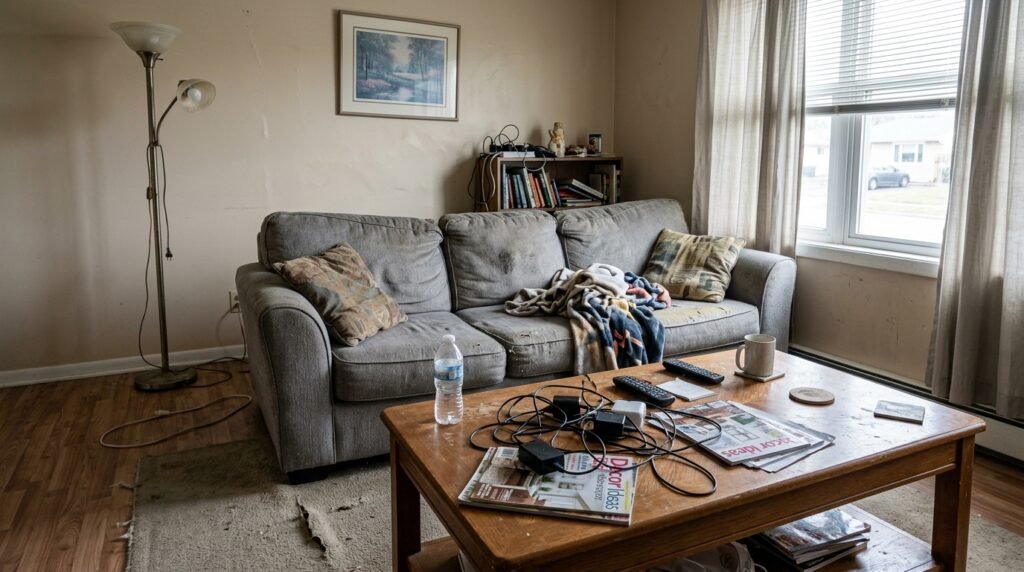
You walk into a friend’s place and it just looks expensive. Same square footage as yours, similar budget, arguably worse furniture. So why does your home read as builder-grade and theirs reads as designed? The answer is rarely money. It comes down to a short list of mistakes that make your home look cheap, and most of them cost nothing to undo.
The things that make your home look cheap have little to do with price tags. They show up in signals: flat light, proportions that fight each other, finishes that do not agree. The eye catches these in under a second, long before anyone clocks whether the sofa was 400 dollars or 4,000.
This guide names the 12 worst offenders and gives you the fix for each, ranked by impact and tagged with real cost. You will also get a priority table, 2026 data on how much presentation moves a home value, and the questions people search most. Renting? There is a separate fix path on every point that needs one.
Why a Room Reads as Cheap and Makes Your Home Look Cheap
The principle behind the whole list: a space looks cheap when it gives away that no decisions were made. Builder-grade everything, furniture pushed flat to the walls, one harsh ceiling light doing all the work. Functional but unconsidered, and people feel that instantly even when they cannot name why.
Designers fix this by working three levers: light, proportion, and material contrast. Nearly every mistake that can make your home look cheap is a failure in one of those three. Once you see the pattern, the fixes stop being rules to memorize and start being obvious.
The one-second test: stand in your doorway, look for two seconds, then look away. What did your eye land on first? If it is a tangle of cords, an undersized rug, or a bare bulb, that is project one. Trust the instinct – it is the same one your guests have. The flip side of this list – how to make your home look expensive with simple decor tricks – uses the exact same levers.
The 12 Mistakes That Make Your Home Look Cheap, Highest Impact First
Top to bottom, this is roughly the order a designer would tackle a tired room. The early ones change the whole feel of a space. The later ones are polish.
1. One Harsh Overhead Light Doing All the Work
A single ceiling fixture flattens everything, kills shadow, and makes good furniture look like a catalogue return. It is the fastest way to make a room feel like a rental nobody loves.
The fix
Layer three light sources at different heights: ambient, table-height, and something low or directional. Use warm bulbs around 2700K (a soft yellow-white) in living and sleeping areas. Three lamps and a dimmer transform a space more than any furniture purchase at the same price.
Renter fix: plug-in floor and table lamps only, no wiring. A clip light bounced off the ceiling fakes a ceiling wash for under 20 dollars.
2. The Rug That Is Too Small
This is the most common giveaway of an amateur room. A rug floating in the middle, with furniture marooned around it, shrinks the space and signals that nothing was measured.
The fix
The front legs of every major seat should sit on the rug. In a living room that usually means 8×10 feet minimum, often larger. On a budget, layer a small patterned rug over a large natural-fibre one. It costs less than one mid-size designer rug and looks deliberate.
3. Furniture Shoved Flat Against Every Wall
An instinct from small bedrooms that follows people into rooms that do not need it. It creates a dead pool in the middle and a waiting-room feel around the edges.
The fix
Float the sofa even a few inches off the wall. Angle a chair. Let the rug, not the walls, define the seating zone. This costs nothing and is the highest return-on-zero-dollars move on the list.
4. Tiny Trinkets Scattered Everywhere
Every surface dotted with small objects reads as visual static. The eye has nowhere to rest, so the room feels cluttered no matter how clean it is.
The fix
Group small items into one tray or a cluster of three, and clear the rest off entirely. One larger object has more presence than ten small ones. Editing is free and usually the highest-impact thing you will do all weekend.
5. Builder-Grade Hardware Left Untouched
Shiny builder knobs, plastic switch plates, the towel bar that came with the unit. Individually minor, collectively they shout that nothing here was chosen.
The fix
Swap cabinet pulls, door handles, and switch plates. Pick two metal finishes for the whole home and commit. A kitchen worth of good pulls runs 40 to 120 dollars and reads as a renovation it is not.
Renter fix: keep the originals in a labelled bag, install your own, reverse on move-out. Screwdriver-only, no landlord conversation needed.
6. Curtains Hung at the Window Instead of the Ceiling
Rod mounted right at the frame, panels ending above the floor in an awkward flood. It chops the wall and lowers the apparent ceiling, the opposite of what you want.
The fix
Mount the rod close to the ceiling and wide past the frame, so panels just kiss the floor. Same window, same curtains, dramatically taller-feeling room. Bare windows and lone vinyl blinds fall under this too: add a fabric panel even over functional blinds.
Renter fix: tension or pressure-mount rods get the height with no holes.
7. Everything Matching as a Set
The sofa, loveseat, and chair that came together. The bedroom suite where every piece is the same finish. Matched sets read as showroom because no human accumulates a room that way.
The fix
Break one piece out. Swap the matching chair for a different material or era. Mix wood tones on purpose. The room should look gathered over time, even if it was not.
8. Art Hung Too High
Art creeping toward the ceiling, disconnected from the furniture below it. This is the most fixable mistake here and one of the most common.
The fix
Center the piece around 57 to 60 inches from the floor. Over furniture, keep the bottom edge six to ten inches above the sofa or console so they read as a pair. Cost: a pencil and a second nail hole.
9. A Room With No Texture
All smooth, all one material, often all the same temperature of grey. Technically tidy, completely flat. It photographs fine and feels lifeless in person.
The fix
Add three contrasting textures to any dead room: something woven, something wood or natural, something soft with weight. A nubby throw, a rattan basket, a linen cushion. Texture is what a camera cannot fake and a cheap room is always missing.
10. Obvious Fake Plants and Dusty Silk Flowers
A glossy plastic feel and a film of dust photograph exactly what they are. Bad faux greenery cheapens a room more than having no plant at all.
The fix
One real low-maintenance plant beats five fake ones. Snake plants, ZZ, or pothos survive neglect and bad light. If faux is the only option, buy one good stem and put it where nobody studies it up close.
11. Visible Cord Chaos
A nest of black cables under the TV, a charger snaking up the nightstand. Nothing undoes a careful room faster, and almost nobody addresses it.
The fix
Cord channel, a few clips, a box for the power strip. Under 25 dollars and twenty minutes for the single biggest “why does it suddenly look finished” effect on the list.
12. The Wrong White (or No Color Plan at All)
Cool blue-white walls under warm bulbs, or a different unrelated color in every room. The house never settles because nothing relates to anything else.
The fix
Pick one whole-home palette: a dominant neutral, a secondary, one accent (roughly a 60/30/10 split of the three). Test paint on the actual wall at night under your actual bulbs first. Wrong-undertone white is the most expensive cheap-looking mistake to discover late.
Renter fix: large art and textiles carry a palette without paint; peel-and-stick handles an accent wall reversibly.
What to Fix First to Avoid Mistakes That Make Your Home Look Cheap
If you only have a weekend or a small budget, work down this list. It is sorted by visual impact against effort and cost, so the top rows give you the most noticeable change for the least spend.
| Fix | Cost | Effort | Why it ranks here |
| Declutter surfaces | Free | 1-2 hrs | Biggest free change; resets the whole room |
| Float furniture off walls | Free | 30 min | Zero-dollar move with outsized payoff |
| Hang art at eye level | Free | 30 min | Fixes a dead giveaway with a pencil and a nail |
| Tame the cords | Under 25 USD | 20 min | Tiny spend, disproportionate finished effect |
| Layer the lighting | 60-150 USD | 1 hr | Single highest-impact purchase on the list |
| Raise the curtain rods | 0-30 USD | 30 min | Makes ceilings feel taller for free |
| Right-size the rug | 120-400 USD | 1 hr | Removes the clearest amateur signal |
| Swap hardware | 40-120 USD | 2-3 hrs | Reads as a renovation it is not |
| Add texture layers | 50-150 USD | Shopping | What a cheap room is always missing |
| Repaint to one palette | 150-500 USD | Weekend | Highest cost, highest ceiling on payoff |
The 2026 Data: Presentation Has a Dollar Value
This is not only about taste. How a home presents has a measurable effect on what people will pay for it, and the 2026 numbers make the case for fixing the mistakes that make your home look cheap before any sale.
The National Association of Realtors 2025 Profile of Home Staging found that 29 percent of agents reported staging produced a 1 to 10 percent increase in offer value. Nearly half (49 percent) said staged homes spent less time on the market. Against the U.S. median home price, recent analyses put that swing at roughly 4,000 to 42,000 dollars depending on the property.
Spending stays modest relative to that. NAR 2025 data put the median professional staging cost near 1,500 dollars, with owner-handled presentations closer to 500. The recurring advice in the 2026 reporting is not “spend more.” It is declutter, clean, and fix the obvious – which is the same free work at the top of the table above.
One shift matters for 2026: with effectively all buyers starting their search online, the first impression is now a photograph. These mistakes read even harder in a wide-angle listing shot than in person, which raises the stakes on getting them right.
The takeaway: the cheap-looking signals in this guide are not only aesthetic. They map onto the same factors that move offer prices and days-on-market in current real estate data. Free fixes, measurable return. For the bigger picture, see our roundup of the best ways to increase your home value before selling.
Pro Insights: Habits That Make Your Home Look Cheap
The mistakes above that make your home look cheap are the well-trodden ones. These are the habits that separate a room that looks fine from one that looks intentional.
- Trim before you buy. Removing the wrong items does more than adding the right ones. Edit hard before spending; you will usually find you need less, not more.
- Raise the line of sight. Curtains high, art at eye level, a tall lamp in a corner. Cheap rooms hug the floor; designed rooms pull the eye up.
- Two metals, total commitment. Pick two finishes and repeat them everywhere. Consistency reads as money more reliably than any single expensive object.
- Photograph the room. Shoot it on your phone. The camera flattens flattery and shows the clutter, the small rug, and the floating art the way a guest eye does.
- Spend where hands and eyes land. Put money into what is touched and seen close up (door hardware, the throw, light quality) and save on what is not.
Renting vs Owning: Two Fix Paths
Most guides assume you can paint and drill freely. Plenty of readers cannot. The same fixes that make your home look cheap still apply to renters – with one extra constraint: reversibility. Here is how the highest-impact fixes split.
| Mistake | If you own | If you rent |
| Bad lighting | Add fixtures, install dimmers | Plug-in lamps, smart bulbs, no wiring |
| Builder hardware | Replace permanently | Swap and store originals; reverse on exit |
| Wrong wall color | Repaint to one palette | Large art, textiles, peel-and-stick |
| Low curtain rods | Mount high into studs | Tension or pressure-mount rods, no holes |
| Small rug | Buy correctly sized | Same fix; rugs are renter-portable |
| No texture | Built-ins, materials | Throws, baskets, cushions, fully portable |
Frequently Asked Questions
What is the number one thing that makes your home look cheap?
Lighting, by a wide margin. A single harsh overhead fixture flattens a room and makes quality materials look synthetic. Layering in two or three warm light sources at different heights is the fastest, cheapest way to make any space read as more expensive.
How can I make my home look expensive on a budget?
Declutter first (free), float furniture off the walls (free), fix lighting and curtain height (cheap), then add texture and right-size the rug. None of that requires a large outlay, and in that order it produces visible change within a weekend.
Why does my room look cheap even though my furniture was expensive?
Expensive furniture in a poorly lit room, on an undersized rug, pushed flat against the walls, still looks cheap. The mistakes that make your home look cheap are about light, proportion, and arrangement, not price tags. Good pieces need a good setting to read as good.
Do fake plants make your home look cheap?
Obvious, dusty ones are. A single high-quality faux stem placed where nobody inspects it closely is fine. One real low-maintenance plant almost always beats several cheap fake ones for a fraction of the visual cost.
How high should I hang art and curtains?
Art: center around 57 to 60 inches from the floor, and over furniture keep the bottom edge six to ten inches above the piece. Curtains: rod near the ceiling, panels wide of the frame and just brushing the floor. Both fixes are free and both are commonly gotten wrong.
Does how my home looks actually affect its value?
Yes. NAR 2025 data shows roughly 29 percent of agents reported staging lifted offers by 1 to 10 percent, with about half reporting faster sales. The free fixes in this guide overlap almost exactly with the presentation factors that move those numbers.
What is the single highest-return change for zero dollars?
Pulling clutter off every surface, then floating the furniture off the walls. It costs nothing, takes an afternoon, and changes the feel of a room more than most furniture purchases at any price.
Start With One Room and Stop Mistakes That Make Your Home Look Cheap
None of this needs a renovation budget. The list is sorted so the top of it costs nothing, and the data backs up that presentation, not spend, is what moves how a home reads and what it is worth.
Pick one room. Do the doorway test, fix the first three free things, then layer the light. Most of the mistakes that make your home look cheap are reversed before you spend a cent, and after that you will know exactly where the money should go.
Your move: walk into your main living space now, give it the two-second doorway test, and write down the first cheap-looking thing your eye lands on. That is project one. Start there this weekend, then work down the priority table from the top.